
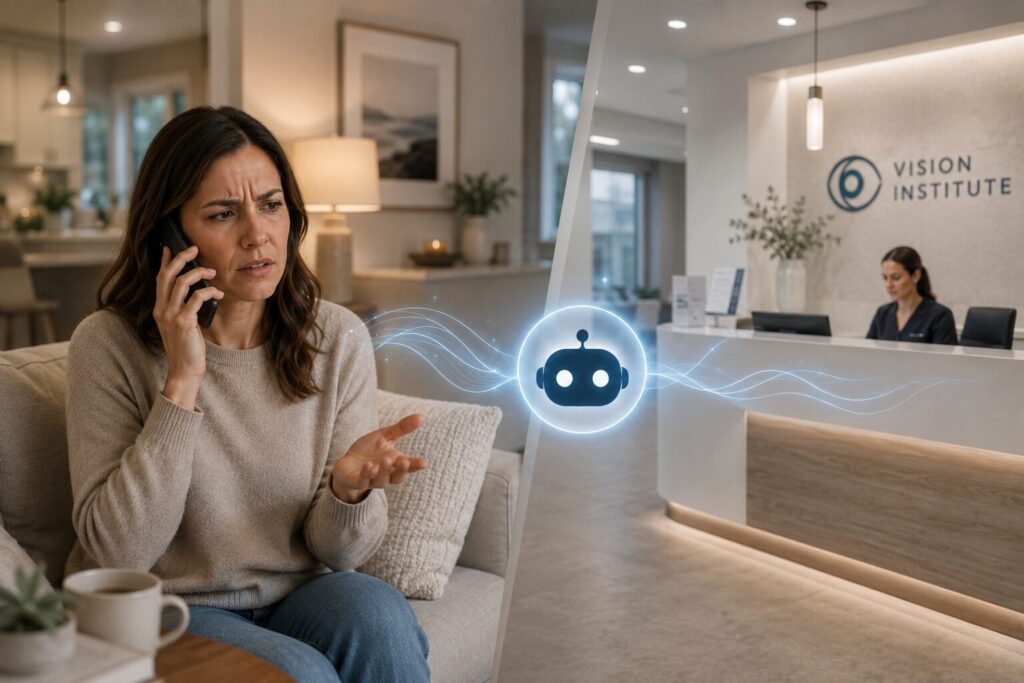
When AI Falls Short (and Your Patients Can Tell)
The difference between generic AI and AI built for elective medicine.
There is no shortage of companies selling AI receptionist technology to medical practices right now. The pitch is consistent: faster responses, lower overhead, 24/7 availability. On paper, it makes sense. But AI that wasn’t built around how elective medical patients think or feel in their decision process tends to show its gaps fast, sometimes in ways that cost a practice a consultation before the call even gets going.
Details Matter
Recently, someone on our team called a practice to evaluate their AI receptionist. The greeting played, and the AI mispronounced the word LASIK. Not a complicated term. It’s the procedure the practice is named after, and it shows up in nearly every call they get.
A patient considering a $5,000 elective procedure just heard the practice’s AI stumble on the most basic word in its vocabulary. That’s not just a technical glitch, but a first impression.
This is the kind of thing most technology companies never catch. They build for uptime and response speed, not for the details that impact the patient experience and how it feels to engage with your practice.
We’ve spent 24 years inside this space. We can tell the difference between a patient who’s still researching and one who’s ready to book, and that a premium IOL patient asks different questions than a LASIK candidate.
That knowledge doesn’t come from a dataset. It comes from experience.
What Patient Reviews Revealed
Every month, OptiCall commissions independent patient satisfaction surveys. The results aren’t filtered through our reporting or framed by our language. They come directly from patients who interacted with our systems.
Here’s what survey results showed:
4.8Average Satisfaction |
4.8Call Handling |
4.7Issue Resolution |
4.8Comfort with AI |
All scores out of 5. All from an independent third party.
The number that matters most is the last one. A 4.8 out of 5 for comfort speaking with AI means patients didn’t feel like they were navigating a system. They felt like they were talking to someone who could help them.
This happens when AI is trained on real patient conversations and real clinical vocabulary, not generic scripts.
What Understanding the Patient Journey Actually Means
Every AI company claims to understand the patient journey. For us, that means a few specific things.
- It means knowing a patient calling about LASIK at 6 PM on a Tuesday is probably researching after work, and the goal isn’t to close, it’s to earn the next conversation.
- It means knowing that someone who says they’re “just gathering information” isn’t a cold lead, they’re early in a decision that could take weeks.
- And it means knowing how a practice sounds in the first fifteen seconds can decide whether a patient stays on the line or moves to the next search result.
Generic AI handles calls. Experienced AI engages patients, and that difference comes from context built over years, not deployed overnight.
What That Looks Like in Practice
Last month, OptiCall’s systems handled real patient interactions across practices in ophthalmology and elective medicine. The results were measurable.
- Over 100,000 calls routed through OptiCall’s Intelligent Router across multiple practices
- 28% average call diversion rate, with one practice reaching 47%
- 740 after-hours patient interactions managed by the Virtual Patient Coordinator
- Patients received scheduling links, callback requests were logged, and live transfers were made when appropriate
- Zero of those interactions required a staff member to stay late
Those numbers come from systems designed around patient behavior, not generic call center logic.
In Their Own Words
From the same survey, patients described their experience in their own words. One response stuck with us:
“Made it all easy, and easy to understand.”
Easy is the standard. Not frustrating, complicated, or time consuming. Just …easy.
When a patient describes a healthcare interaction that way, it means the system stayed out of their way. The language was clear, the process made sense, and they left feeling like someone was actually paying attention.
That’s what 24 years in elective medicine produces. Not just technology that works, but technology that feels like human nature.
See How OptiCall Handles Patient Conversations Differently
About OptiCall
OptiCall is a healthcare communication and patient-access partner serving ophthalmology, refractive surgery, aesthetics, and elective medical practices. Since 2002, we have helped practices protect every patient opportunity through live and AI-supported conversations, routing, and capture systems. Our AI is built from real patient calls, not assumptions.
